
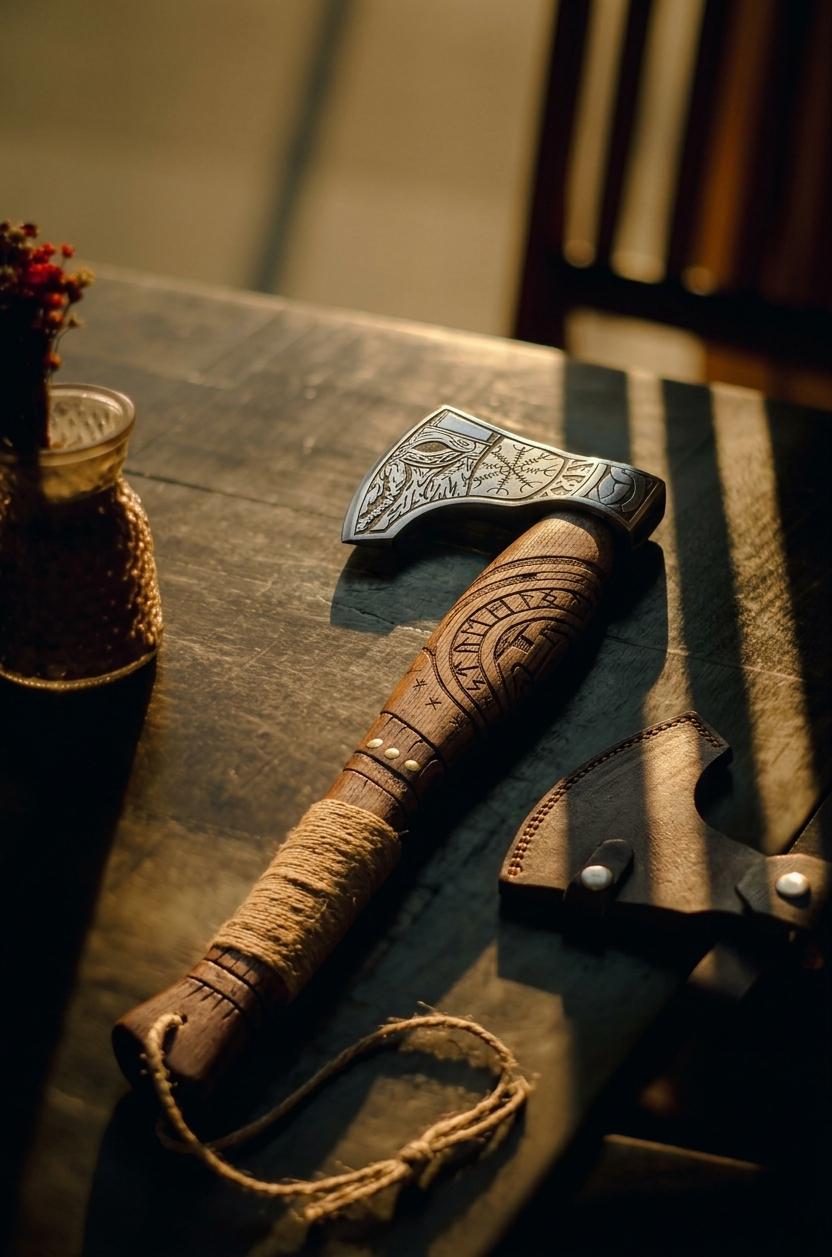
A handmade blade is already personal, but engraving makes it unique. A name, a date, a symbol or a few words can turn a fine tool into a keepsake that carries meaning for decades. This guide covers the main engraving methods, the best places to put a mark on an axe, sword or knife, and ideas for personal messages, family crests, Norse runes, weddings and memorials, including the accuracy pitfalls that are easy to fall into.
How Blades Are Engraved
Different methods suit different designs, and each has trade-offs.
- Hand engraving: a skilled engraver cuts lines into the metal with a sharp tool called a graver. It produces crisp, flowing, one-of-a-kind work and is the traditional method for ornate designs, but it is slow, specialist work, and cutting fully hardened steel is difficult.
- Laser engraving: a laser marks or removes a thin layer of metal. It is precise, repeatable and good for text, logos and fine detail, and it is widely used for names and dates. Depth varies by machine and settings.
- Acid etching: the design is protected by a resist and the exposed steel is eaten away by a mild acid such as ferric chloride. It gives a soft, shallow, often dark mark and is also used to reveal patterns in pattern-welded steel.
- Stamping: hardened steel dies are struck into the metal. It is quick and good for maker’s marks, but it is not suited to long text or delicate designs and must be done carefully.
- Chasing, carving and inlay: decorative techniques used on guards, pommels and fittings, often in brass, bronze or other softer metals, and sometimes in wood or horn handle materials.
If you are unsure which suits your idea, describe the design to the maker and ask for their recommendation.
Where to Put the Engraving
Placement affects both how it looks and how the tool performs.
- Blade flat or ricasso (the unsharpened section near the handle on many knives and swords): the classic place for names, dates and short messages.
- Spine or back of the blade: subtle and elegant, good for discreet messages.
- Guard, crossguard and pommel (swords): ideal for crests, runes and ornamental work. Metal fittings are often softer and easier to decorate.
- Handle plates, bolsters or bands: a small metal plate or end cap makes a neat, replaceable place for a name or date.
- Axe cheek (the flat side of the head): a popular, visible location for symbols and names.
- Wooden handle or haft: burned or carved designs, which can be lovely but do not last as long as metal.
- Sheath or scabbard: leather can be tooled, stamped or embossed to match the blade.
Practical cautions: deep cuts or heavy stamping in high-stress areas, such as the tang area of a sword or near the edge, can create weak points where cracks may start. Keep engraving shallow in such areas and ask the maker where it can safely go. Also consider that carbon steel will develop a patina over time, which can darken or soften the look of fine engraving, and a light coat of oil helps preserve it.
Personal Messages
Short, meaningful words work best because engraving space is limited and tiny text becomes hard to read.
- Names, initials and monograms: timeless and always appropriate.
- Dates: birthdays, wedding dates, retirement dates and milestone events. Roman numerals give a classic look.
- Short phrases and mottos: a line the recipient values, a favourite quotation or a family saying.
- Coordinates: the location of a wedding, a hometown or a special place.
- Handwriting or signatures: a loved one’s real handwriting can be copied into the design, which makes a very personal gift.
- Maker’s mark and date: the maker’s own mark helps document authenticity.
Tips:
- Keep it short. A few words or one line often looks best.
- Choose a clear, readable font. Fancy scripts can lose detail at small sizes.
- Proofread carefully. Engraving is permanent. Check spelling, dates and punctuation, ideally with a second person, and confirm the final text with the maker in writing.
- If you use a foreign language or a Latin phrase, have it checked by someone who knows the language, since online translations of mottos are often wrong.
Norse Runes
Runes are one of the most requested designs, and also one of the easiest to get wrong. A few facts help you choose well.
- There is more than one runic alphabet. The Elder Futhark has 24 runes and was used from roughly the 2nd century onward. The Younger Futhark has 16 runes and was the script of the Viking Age (roughly the 8th to 11th centuries and beyond). The Anglo-Saxon Futhorc is a related English variant. If your theme is the Viking Age, the Younger Futhark is the historically appropriate choice.
- Runes are not a simple letter-for-letter code for English. Runes represented the sounds of early Germanic languages, and the Younger Futhark has far fewer symbols than there are sounds, so one rune could stand for several. Modern names are usually “transliterated” for engraving, which is a creative choice and not a historical spelling. Ask the maker or a specialist how the text will be rendered, and say which alphabet you want.
- Old Norse phrases are more authentic than transliterated English. If you want a real phrase, have it checked by someone with knowledge of Old Norse or runology, rather than trusting a random website.
- Rune names and meanings: the Younger Futhark runes have traditional names such as fé, úrr, þurs, áss, reid, kaun, hagall, náuðr, ís, ár, sól, týr, bjarkan, maðr, lögr and yr. Many of the “mystical meanings” on the internet are modern and not well supported by evidence, so be wary of overconfident claims.
- Weapons with runic inscriptions exist but are not the norm. Some weapons and fittings from the early medieval period do carry runes. By contrast, the famous Ulfberht swords carry a name inscription in Latin letters. Many Viking-style replicas use runes as decoration, which is a perfectly good choice as long as it is described honestly.
- Be careful with modern “Viking” symbols. Some popular designs are not from the Viking Age. The Vegvísir, for example, is first documented in a 19th-century Icelandic manuscript, and the “Web of Wyrd” is a modern creation. The valknut and Thor’s hammer (Mjölnir), by contrast, have genuine Viking-Age evidence. If historical accuracy matters to you, ask about the source of the symbol.
- Check for misuse. Some runes and Norse symbols have been adopted by extremist groups. It is worth checking that a particular combination does not carry an unwanted association, and a good maker will be glad to discuss this with you.
A short, historically grounded inscription, such as a name or a simple Old Norse phrase, usually looks far better than a long string of decorative symbols.
Wedding Pieces
Wedding engraving ranks among the most meaningful.
- Names and date: the couple’s names or initials with the wedding date.
- Vows or a short phrase: a line from the ceremony or a favourite quotation.
- Coordinates or place name: where the couple married or met.
- Matching sets: two pieces engraved to complement each other, such as a knife for each partner.
- Groomsmen and bridal party gifts: each piece engraved with a name or initials, and perhaps the wedding date.
- Ceremonial pieces: a sword or axe used in a ceremony, such as a handfasting-style or themed wedding, engraved with the couple’s names and the date.
- Anniversary engraving: a piece given on a later anniversary, with the original wedding date and the anniversary year.
Plan ahead, since custom engraving adds production time, and confirm the delivery date well before the wedding.
Memorial Pieces
A memorial piece honours a person or a life, and it needs particular care and sensitivity.
- Name, dates and a short phrase: simple and dignified.
- A loved one’s handwriting or signature: a personal and moving detail.
- A symbol of their life: an anchor, a tree, a tool, a badge, a crest or an emblem tied to their work or interests.
- Restoring or reusing a family tool: a handle or sheath for an inherited blade, or a new piece made in memory of the original.
- Materials with meaning: a handle made from wood from a family tree or a special place, if the maker can work with it.
- Remembrance gifts: a knife or axe given to family members, each engraved with the person’s name and dates.
Talk openly with the maker about what you have in mind and the timing, and give yourself time. A good maker will treat the request with care.
How to Order Engraving: A Checklist
- Decide the text or design and keep it short and clear.
- Choose the method with the maker’s advice.
- Choose the placement with safety and appearance in mind.
- Supply clear artwork if you want a crest, logo or handwriting.
- Proofread and confirm the final wording in writing.
- Ask about timing and cost, since personalized work often takes longer and costs extra.
- Check the return policy. Engraved pieces are usually made to order and may not be returnable.
- Plan the care: keep carbon steel dry and lightly oiled so the engraving stays clear.
Ready to Make It Yours?
Engraving turns a handmade blade into something that belongs to one person or one family. If you have an idea, even a rough one, tell us the occasion, the message or symbol you have in mind, and we will help you shape it into a piece worth keeping.
Note: engraving options, available methods, lead times and policies vary by maker and by piece, so please contact us to confirm what is possible for your chosen item. Heraldic rules and runic scholarship are specialist areas, and when historical accuracy matters, consult a qualified source.