
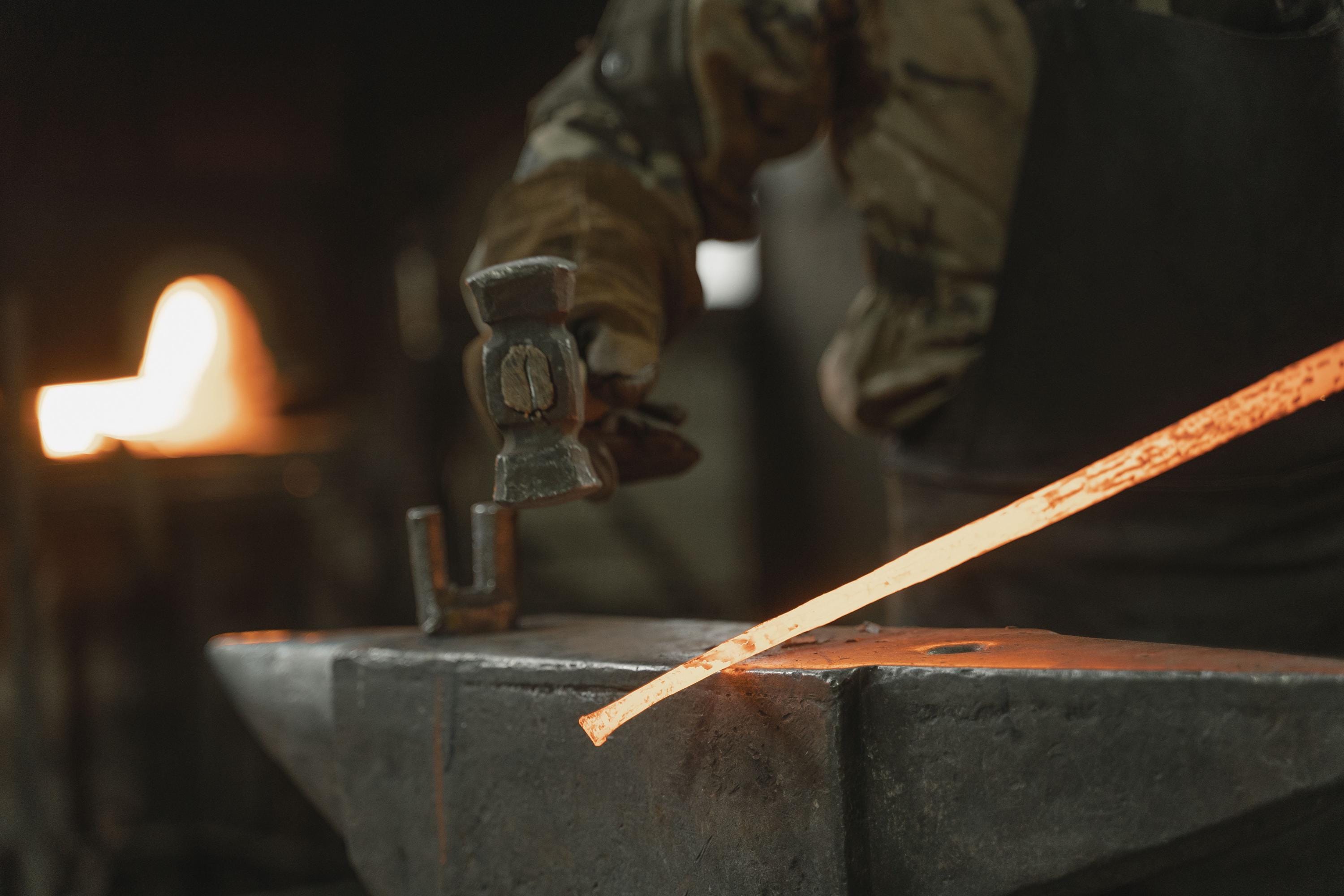
Every blade we sell begins as a plain bar of steel and ends as something you can hold, use and pass down. Between those two points sit dozens of decisions, a great deal of heat and a lot of patience. This post walks through the whole process, step by step, so you know what goes into a handmade piece and why it costs what it does.
1. Choosing the Steel
Everything starts with the steel, because no amount of skill can make a poor material perform well. Steel is iron with a small amount of carbon (and sometimes other elements), and the recipe decides how the blade behaves.
- Simple high-carbon steels (1060, 1075, 1084, 1095): The workhorses of bladesmithing. They are tough, forgiving to heat treat, easy to sharpen and take a keen edge. The number reflects the carbon content: 1095 has about 0.95% carbon and is harder and holds an edge longer, while 1060 and 1075 are tougher and better suited to larger, shock-loaded tools such as axes and swords.
- Spring steels (5160, 9260, 6150): Alloyed with chromium or silicon, these are prized for toughness and flexibility. 5160 is a classic choice for swords, large knives and axes because it bends and recovers rather than breaking.
- Tool and alloy steels (80CrV2, 52100, O1, 8670): Small additions of chromium, vanadium, manganese or molybdenum improve toughness, grain structure and edge holding. 80CrV2 and 52100 are popular for knives and axes alike.
- Stainless steels (such as 440C, or modern powder steels): Chosen where corrosion resistance matters, mostly for knives. They require more precise, often furnace-controlled heat treatment.
- Wrought iron and mild steel: Used in traditional axe construction, where a soft iron body is combined with a hard steel cutting edge.
- Pattern-welded ("Damascus") steel: Two or more steels, typically a high-carbon steel and a nickel-bearing steel such as 15N20, are forge-welded together and manipulated to create patterns. This is both a decorative and a functional technique.
Choosing the right steel means matching the tool to its job: a hard, fine-edged kitchen knife has very different needs from a long sword that must flex, or an axe that must survive being driven into wood.
2. Design and Planning
Before the fire is lit, the piece is designed. This covers the overall shape, length, weight, balance, blade profile, cross-section and how the handle will attach. A sword's balance point, an axe's head weight and the geometry of a knife's edge all determine how it feels and performs. Many makers sketch the design, make a paper or cardboard template, and calculate the amount of steel needed so there is enough to forge the shape without waste.
3. Forging: Shaping the Steel with Heat
Steel is heated in a coal, gas or induction forge until it glows a bright orange to yellow, roughly 1,000 to 1,200°C (about 1,800 to 2,200°F). At these temperatures it becomes plastic enough to move under the hammer, whether struck by hand or by a power hammer or press.The key stages are:
- Drawing out: Hammering the bar to lengthen and thin it.
- Profiling: Defining the outline of the blade, including the point, the tang and any curves.
- Bevel forging: Hammering the cutting edge geometry in, so less material has to be removed later.
- Fullers (for swords): A groove along the blade that lightens it without sacrificing stiffness, forged in or ground in later.
A few rules matter greatly: steel should not be hammered once it cools below a dull red, because working it cold can cause cracks and internal stress, and it must not be overheated to the point of sparking or "burning," which permanently ruins it. Forging also refines the internal grain of the steel and aligns it with the shape of the blade, which is part of what makes a forged piece distinctive.
How axes are different
An axe head has a feature knives and swords lack: the eye, the hole through which the handle passes. There are two traditional ways to make it.
- Punching and drifting: The hot steel is punched through and the hole is expanded and shaped with a tapered tool called a drift.
- Folding (wrapped eye): A bar is drawn out, bent around a mandrel and forge-welded closed, which is a classic historical technique.
Many traditional axes, including bearded axes of the Viking era, were built with a softer iron body and a hard steel bit forge-welded into the edge. This conserved expensive steel while giving a tough body and a hard edge, and it remains a respected method today.
Forge welding
When separate pieces are joined (a steel bit to an iron body, or layers in pattern-welded billets), they are heated to welding heat, typically around 1,200 to 1,300°C, coated with flux (usually borax) to keep oxide off the surfaces and then hammered together until they fuse into one solid piece.
4. Normalizing and Annealing
Forging leaves stress and an uneven grain structure in the steel. To correct this, the piece goes through normalizing, which means heating it to just above its critical temperature and letting it cool in still air, repeated two or three times at decreasing temperatures. This refines the grain, which is vital for toughness. Many smiths then anneal the piece by heating it and cooling it very slowly, leaving it soft enough to be filed, drilled and ground accurately.
5. Rough Grinding and Profiling
With the steel soft, the blade is cleaned up and shaped. Excess material is removed, bevels are ground, the tang is finalized and holes for pins are drilled. Edges are typically left fairly thick at this stage (a thickness often called "leaving the edge at the thickness of a dime"), because thin edges can warp or crack during hardening.
6. Heat Treatment: Where the Blade Is Truly Made
Heat treatment is the single most important step in the life of a blade. Done correctly, it gives hardness and toughness in the right balance. Done badly, it produces something brittle or soft, no matter how beautiful it looks.Hardening (austenitizing and quenching): The blade is heated evenly to its critical temperature, which for most high-carbon steels is around 780 to 850°C (1,430 to 1,560°F) depending on the alloy. At this point the steel becomes non-magnetic, and the smith holds it there briefly before plunging it into a quenching medium such as oil (the usual choice for most steels) or water or brine for certain very simple steels. The rapid cooling locks the steel into an extremely hard but brittle structure called martensite.Tempering: A freshly quenched blade is too brittle to use, so it is tempered immediately by reheating it to a lower temperature, commonly between about 150 and 450°C depending on the tool, and holding it there, often in two or three cycles. Tempering trades a little hardness for a great deal of toughness.Target hardness is measured on the Rockwell C scale (HRC) and varies by purpose:
- Knives: typically 56 to 62 HRC, depending on use and steel.
- Axes: typically 50 to 58 HRC at the edge, with the rest of the head softer for impact resistance.
- Swords: typically 48 to 58 HRC, with the blade kept tough and springy so it flexes and returns rather than snapping or taking a permanent bend.
Differential hardening: Some makers harden only the edge while leaving the spine softer and tougher, usually by coating the spine with clay before quenching. This produces a visible temper line, called a hamon when it is a feature of the finished blade. Many axes and swords benefit from this approach because it combines a hard edge with a shock-absorbing body.
7. Final Grinding and Finishing
After heat treatment, the blade is ground to its final geometry using belt grinders, files, stones or all three. The edge is thinned to its final profile, and the surface is refined through progressively finer abrasives. Finishes include:
- Satin or hand-sanded: A clean, fine linear finish.
- Mirror polish: Highly reflective, requiring many hours of work.
- Forge finish or hammer finish: The surface left from forging, for a rustic look.
- Etched: The blade is dipped in an acid such as ferric chloride, which reveals pattern-welded layers or the hamon by attacking different steels at different rates.
8. Handles, Guards and Fittings
The handle is as important as the blade. A poorly fitted handle makes a tool unsafe and unpleasant to use.
- Knives: Handles are commonly made from stabilized or seasoned hardwood, bone, antler, micarta or similar materials. They are attached as scales pinned and bonded to a flat tang, or fitted over a hidden tang and secured with epoxy and a peen or pommel nut.
- Swords: These have a guard (crossguard), grip and pommel. The grip is shaped to the hand, often covered in leather or cord, and the pommel is fastened by peening the tang or with a threaded nut, which locks the whole assembly together.
- Axes: The haft (handle) is shaped from a straight-grained hardwood such as hickory or ash, which absorbs shock well. It is fitted to the eye, wedged and secured so the head cannot loosen. The grain direction matters, because it determines how well the haft handles shock and resists splitting.
9. Sharpening and Final Testing
A blade is given its final edge by sharpening on stones, strops or both, and tested for sharpness and edge strength. Typical checks include cutting tests, flex tests for swords (flexing the blade to confirm it springs back true), and inspection of the fit and alignment of every component. Any piece that does not pass is corrected or rejected.
10. Sheaths, Scabbards and Care
A finished blade needs protection. Knives and axes are typically paired with a leather sheath or mask, and swords with a scabbard, often wood-cored and covered in leather. These protect both the edge and the owner.Carbon steel is not stainless, so it needs a little care:
- Wipe the blade dry after use.
- Apply a light coat of oil (mineral oil or a camellia oil is a common choice) before storing.
- Keep it out of damp environments, and never store it in a leather sheath for long periods, because leather can trap moisture.
- Keep edges sharp with proper stones or a strop, and avoid prying with knives or using swords against hard objects.
- Over time, carbon steel develops a patina, a darker protective layer that many owners appreciate as the character of the tool.
Why Handmade Is Different
A handmade blade is the product of dozens of hours of work and a long chain of choices: the steel, the shape, the heat, the fit, the finish. Each piece is unique, built to be used and cared for, and repaired rather than replaced. When you hold one of our axes, swords or knives, you are holding the result of every step above.Have a question about how a particular piece was made, or want to discuss a custom commission? Get in touch, we love talking about the process.Note on figures: temperatures, hardness ranges and heat-treatment details vary with the specific steel, the equipment and the intended use. The values above are typical ranges, not a recipe for any single blade.